
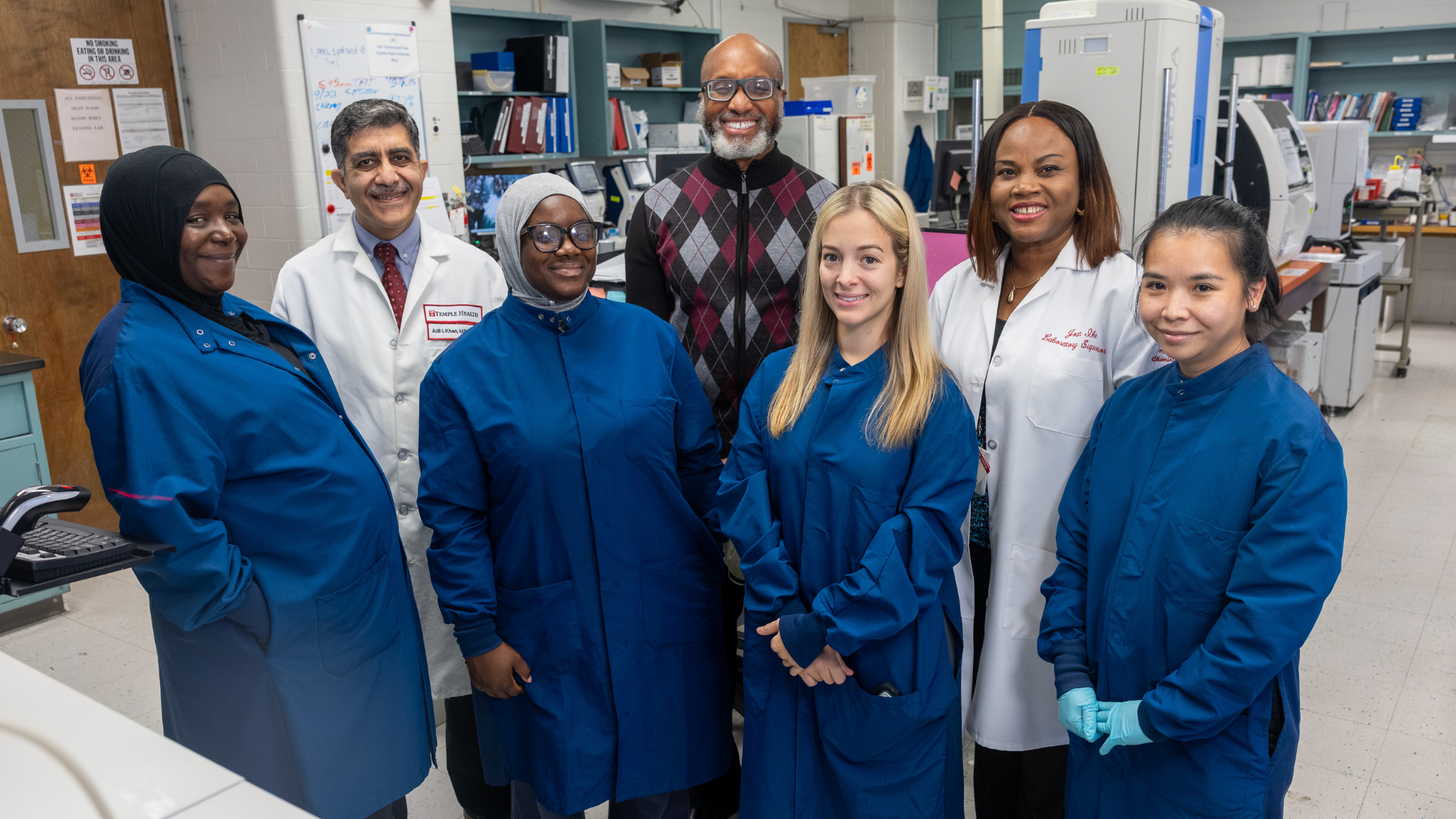
Members of the TUH-Episcopal Campus laboratory testing team include (from left) phlebotomist Tamika Witherspoon, PLB, CCMA; sectional medical director Adil Khan, MSc, PhD; phlebotomist Zahraa Muhammad, PLB; laboratory manager Ian James, BSMT ASCP; medical lab technician Kari Gargel, MLT ASCP; laboratory supervisor Oluchi (Joan) Ike; and lead medical technologist Min Cheung, MT ASCP.
Unofficially, the clock starts ticking the moment that medical technologist Ian James receives a patient’s blood or urine sample. That’s because he and the laboratory team at Temple University Hospital–Episcopal Campus hold themselves to a high standard.
According to the National Institutes of Health, a widely accepted performance benchmark calls for laboratories to complete 90% of three distinct tests (chemistry panel, complete blood count, and troponin) in 60 minutes or less.
The goal for James and his team: Analyze a specimen across those three tests and return accurate, reliable results in 45 minutes or less. For the last 23 months, James and the team have met that goal on at least 90% of the specimens they have analyzed.
Some might view that as a stress-inducing task — and James would agree.
“We, in this profession, would absolutely say this job is stressful,” James said, “but that’s why we love it. We welcome the challenge.”
As laboratory manager of the lab at TUH–Episcopal Campus, James and a team of 23 technologists and phlebotomists collect samples and perform diagnostic testing to help identify the presence of diseases and other health conditions affecting a patient. A laboratory’s ability to reliably return specimen results in a timely manner supports a care team’s ability to more quickly diagnose the patient, contributing to the patient’s shorter length of stay.
James credits several factors that have contributed to the success of Episcopal’s lab, pointing to a multi-year transformation in laboratory operations, technology, staffing, and quality management.
The lab, he said, has benefited from upgraded technology that has improved efficiency, as well as the establishment of what he called “a culture of awareness.” Performance data are measured and communicated daily. The sources of even routine delays are discussed, encouraging the team to identify opportunities to prevent them.
“We enjoy our role as detectives—analyzing a sample, generating a result, and interacting with the doctors and nurses who will make a decision in the treatment of a patient,” James said.
Recently, a patient’s test results revealed low hemoglobin and an antibody to red cells. Performing a transfusion for this patient would require the identification and location of compatible units of blood. James escalated the search.
“We had blood within several hours,” he said. “Making a difference brought great satisfaction.”
According to James, the College of American Pathologists-accredited lab benefits from the contributions of exceptional clinical, administrative, and support staff. The staff includes: Chair of Pathology Yuri Persidsky, MD, PhD; Vice President of Laboratory Operations Jonathan Bakst, MBA, MHS; and medical directors Adil Khan, MSc, PhD; Raghava Potula, PhD; and Meredith Ulas, MD, PhD; as well as Max Manetta, administrative director of laboratory services, and Richard Sowers, quality director.
“Our ability to return results in less than 45 minutes on 90% or greater of the samples we analyze is an achievement that belongs to the entire laboratory team,” James said. “Their consistent attention to turnaround time, willingness to identify and address potential delays, and understanding of the impact of their work on patient care have transformed sustained high performance into part of the laboratory’s everyday culture.”