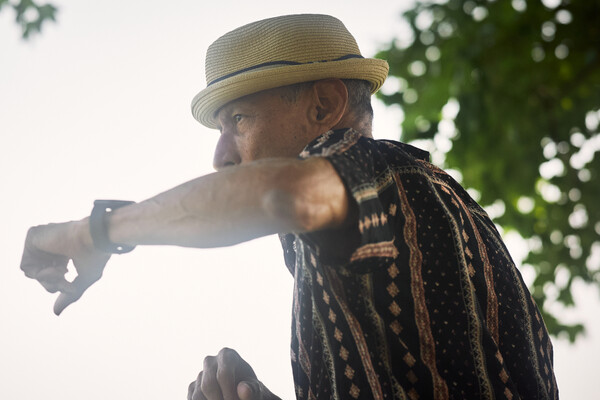
In the early 2000s, Manny began seeing neurologist Mercedes P. Jacobson, MD. When Dr. Jacobson moved to Temple from her previous institution, Manny followed. Dr. Jacobson is part of a Temple Comprehensive Epilepsy Program team that offers a range of advanced seizure-controlling treatments, including medication, implantable anti-seizure devices, state-of-the-art surgeries and access to clinical trials. As a level 3 Epilepsy Center, as designated by the National Association of Epilepsy Centers, Temple offers a high level of expertise to diagnose and treat even the most complex epilepsy cases.
Manny credits Dr. Jacobson and Temple for helping to control his condition and reduce his seizures.
"She was able to treat me and try different things," Manny says. "And she has been successful in helping me."
It's been about eight years since his last grand mal seizure and two years since he had a focal impaired consciousness seizure (formerly called complex partial seizure). A person with this type of seizure may become confused, stare blankly and experience other symptoms.
In Manny's case, a change in his medication regimen has been key. Currently, he takes an anticonvulsant medication called carbamazepine.
"It's keeping me from having seizures," Manny says.
His Temple team determined that he has a fast metabolism, which makes it difficult to maintain an effective level of epilepsy medication at normal doses.
"So, in my particular case, I take a dosage that is a little higher than for most epilepsy patients," Manny says.
Speaking out about epilepsy
For the first several years of his epilepsy journey, Manny didn't talk about his condition very much.
"I was hiding my situation," he says.
In the mid-1980s, that changed in a very public way. At the time, Manny worked as a DJ for a local radio station. One day, he had a seizure while on-air. His young daughter was also in the studio that day to record a commercial.
"She was right behind me, seeing what I was doing, and the people could hear her screaming to get help," Manny recalls. "I was taken to the hospital. Some of my friends who were listening showed up at the station."
For Manny, it felt like a heavy weight had finally been taken off his shoulders. Now everybody knows, he thought. So what?
"That's when I became willing to speak about this," Manny says.
In fact, Manny remains very involved in the epilepsy community, with the hope of inspiring others to advocate for their health. He speaks often with patients and their families, particularly those newly diagnosed with epilepsy. He helps them better understand the condition while dispelling a few myths (no need to place a spoon or other object in the mouth of a seizing person to keep them from swallowing their tongue, for example).
'I just continue to move forward'
Manny retired from a career with an international engineering and construction management company. These days, he enjoys hitting the gym five times a week to shadowbox and work out with a speed bag. His epilepsy has never defined who he is or greatly limited how he has lived his life.
"I just keep moving forward," Manny says.
Living with epilepsy isn't always easy. But his active participation in his care and the backing of his family have remained constant throughout his journey.
"One of the things that has helped me a lot is the tremendous support from my wife and three children," Manny says.
He is also grateful to Dr. Jacobson and his Temple care team for his medical treatments.
"I have received excellent care at Temple," he says. "I am happy to tell other people to at least knock on their door and look for help."
In addition to treating his epilepsy, Temple surgeons have helped Manny overcome many of his seizure-related injuries. They rebuilt his shoulder and placed plates and screws in his pelvis, for example.
"Every time I go there, I get good help," Manny says.
Going to a center that specializes in epilepsy and working closely with your doctors is one of the keys to getting the best possible care, he adds.
"Try to develop a good relationship with your doctors," Manny says. "They are there to help you. And don't be afraid to ask them questions."
Reflecting on his journey, Manny offers this additional message to others living with epilepsy:
"You have to help yourself, and one of the ways to help yourself is you've got to allow yourself to have hope."
Hope is something he continues to find with the epilepsy and seizure experts at Temple.
Helpful Resources
Looking for more information?